Success Stories




Sheikha Hissah
A Kuwaiti Princess & a Working Woman
May 28, 2004
Sheikha Hissah Saad Al-Sabah from Kuwait is a businesswoman who works restlessly to promote awareness of issues affecting women in the Arab world. Her dream is to empower Arab women so they can be more self-reliant and become key players on the business scene.
Sheikha Hissah is a Kuwaiti princess, but also a friendly lady famous for that ever-present smile on her face. Her role as a princess may seem glamorous, but it also consists of several responsibilities. Sheikha Hissah represents her country in a number of international functions, organizes a variety of social events every year, and collaborates with charitable organizations on a continuous basis. In addition to these tasks, she is also an active businesswoman who presides over several nonprofit organizations and is very active in the real estate industry. But what is very dear to her heart is the Council of Arab Business Women, to which she dedicates a lot of her energy and was recently elected president for her second term.
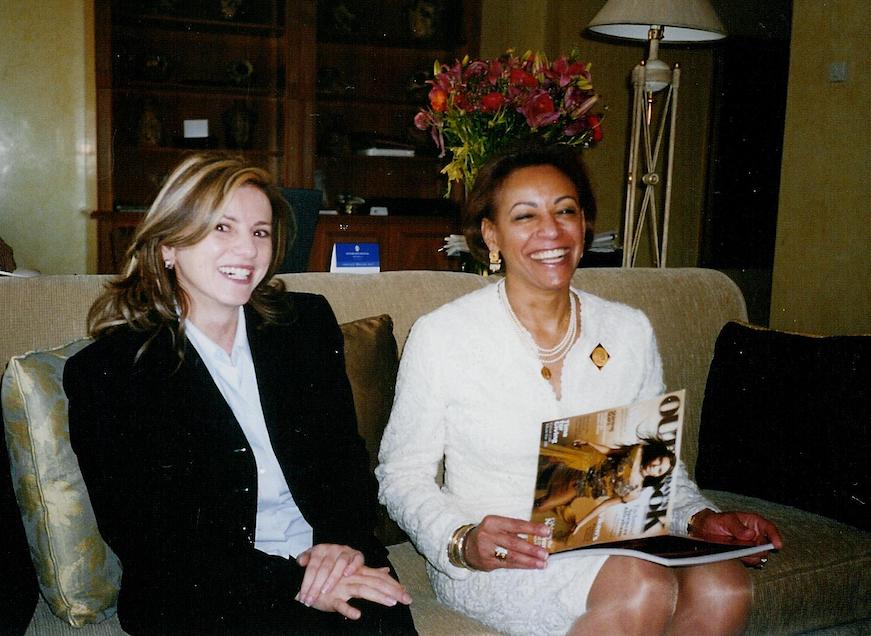
Sheikha Hissah was one of the Arab women who recently came to Beirut to participate in the International Women’s Day. The encounter included many first ladies and royalty members from the region. When Today’s Outlook caught up with the princess, it was amid an entourage of male and female assistants. Her hotel room where the interview took place was set up like an office where serious work was being done. It seemed that Sheikha Hissah didn’t have much time for leisure, although the program in Beirut included a number of fun activities and a visit to Mrs. Hala Fares’ yacht.
Sheikha Hissah knows Lebanon very well. It was here where she lived as a young student before she earned her degree in Hospital Administration from the American University of Beirut. She then pursued a postgraduate degree in the United States, where her only son currently goes to school. After having completed her studies, Sheikha Hissah worked in an American military hospital, where she developed an interest for social work and a strong desire to help improve people’s lives. Today, she is involved in numerous social projects such as the Council for Drug Prevention in Kuwait, which has developed from a national organization into a regional one.
Arab Women at the World Economic Forum – a great success
Though Sheikha Hissah is involved in many organizations, the dearest to her heart remains the Council of Arab Business Women. Last year, the council took part in its first international conference at the Abu Dhabi World Economic Forum, where 900 delegates – all women from different Arab countries – were present. “The event was a great success,” said the princess. “We had expected some 400 ladies to come, but almost a thousand were there.” This was very encouraging and proved that the interest in such an organization and in the role of women in the business world definitely exists.
Organizing such an event required a lot of time and effort. Sheikha Hissah had to travel to most Arab countries and meet with first ladies to discuss and promote the conference. “It wasn’t easy to bring all these women together and to break the barriers,” she said. But her effort was worthwhile and helped to bring the event to fruition. Today, literally all the Arab countries have representatives in the Council of Arab Business Women. “Only the women from Algeria and Mauritania have a difficult stand and can’t attend all our meetings,” she added.
One of the most important goals for Sheikha Hissah is to raise awareness internationally and regionally about the status of Arab women. “Western women could not believe that Arab women are so strong,” recalled Sheikha Hissah when speaking about the World Economic Forum. “My goal is for Arab women to be seen by Western women as equal. Promoting a positive image of Arab women is the number one priority,” she said.
Her second priority is to empower Arab women, assist them in developing their entrepreneurship, and promote their role in Arab business. The goal is to help women strengthen their self-confidence, promote their self-sufficiency so they can work and achieve their own goals in life, and to ultimately play a key role in the development of their national economy. This applies to wealthy women from the Gulf just as much as to female farmers in Egypt.
Sheikha Hissah admits that in countries like Sudan and Egypt, which depend mostly on agriculture, women still lack education and knowledge. “For us as a council, these women are hard to reach,” she said. But even in rural societies, the council tries to empower these women and boost their self-confidence. When a woman works as a farmer, for instance, she should be aware of the fact that she is a good farmer – an expert in her field, so to say.
“The problem remains to be tradition, not religion or education,” the princess explained. “There are societies where women still feel inferior to men, and we’re trying to change that.”
When speaking about Kuwaiti women, Sheikha Hissah draws a completely different picture. She sees them as open-minded, independent, and highly educated women. In addition to that, “Kuwaiti women are powerful because they control their own money,” she explained. “Their husbands or fathers don’t interfere in how to manage or spend that money because it’s personal money that they inherited, and most women know how to invest it wisely.”
That’s where the Business Council comes to play – it is an organization that allows businesswomen to network, communicate, and exchange experiences. Moreover, the organization recently created a website that posts different advertisements for investment opportunities related to everything from real estate to e-commerce.
Although Sheikha Hissah has high-reaching goals for both wealthy princesses and modest rural women, she’s well aware of the fact that nothing works without a minimum respect to the traditional role of Arab women – their role of raising children and maintaining a family. “We always say that the family comes first,” she stated. “But if a mother has the time and the desire to work, then she should work. Some can even run their business from home. If she’s a weaver, she can weave at home. If she’s educated, she can work on the Internet. Having a job doesn’t necessarily mean that you have to leave the house and work in an office.”
Many activities and projects still lie ahead for Sheikha Hissah, including an important exhibition of Arab arts and crafts in Paris next year. She’s hoping to attract as many Arab artists and craftswomen as possible. Sheikha Hissah believes that despite social barriers, these women are part of the workforce and should be included in the Business Council, regardless of their financial status.